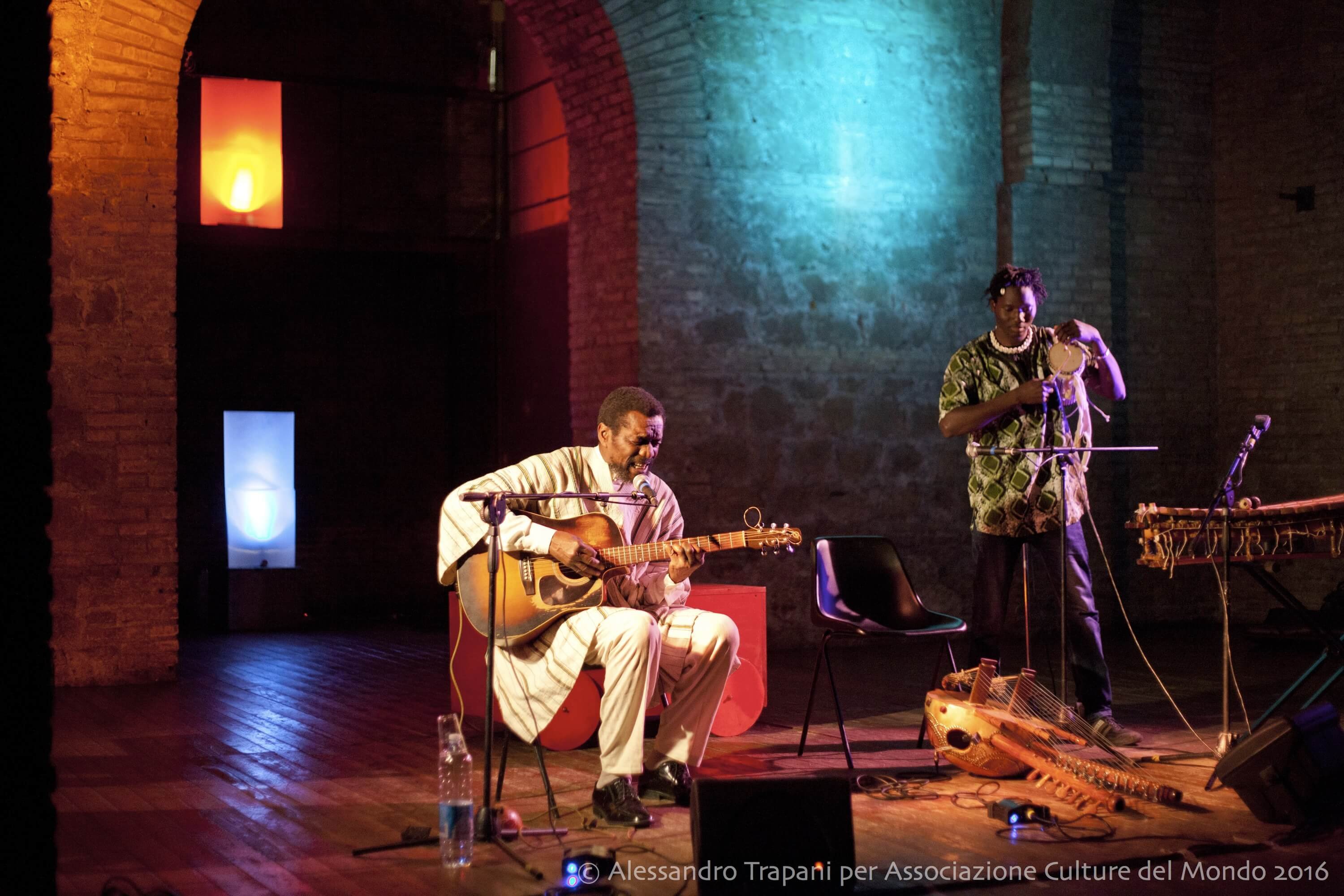
On 28 April 2016, the fourth Accordi di Pace concert brought Gabin Dabiré and Zam Moustapha Dembélé together at Teatro Sala Uno in San Giovanni, Rome. The contemporary record describes Dabiré as a Burkinabè musician and singer-songwriter and Dembélé as a Malian polyinstrumentalist and Bwa griot specialising in balafon and kora.
Unlike the other four encounters, which drew on geographically distant or historically antagonistic traditions, this pairing brought together two musicians from neighbouring countries who shared deep cultural and musical roots in the Sahel.
Source: Culture del Mondo announcement and contemporary 2016 event record.
The context
Proximity is not sameness.
Both musicians arrived carrying traditions in which music is closely connected to memory, community and transmission. Dembélé's family background is explicitly described through the griot tradition — a hereditary lineage of musicians, historians and storytellers central to West African society — and the teaching of music and instrument-making across generations.
Gabin Dabiré's path moved between Burkina Faso, India, Denmark and Italy, developing a practice that crossed between African and Western musical forms. His international career placed him far from any single national tradition.
The meeting placed those histories together in Rome without reducing them to a single idea of "African music."
Source: contemporary 2016 programme and event record; artist biographies.
Where they come from
A locator rather than a political map. Dabiré's Burkinabè origins and Dembélé's Malian griot heritage, converging on Teatro Sala Uno, Rome.
The performance
Teatro Sala Uno · San Giovanni, Rome · April 2016.
Burkinabè singer-songwriter · West African string traditions
Gabin Dabiré's documented practice includes acoustic guitar, voice and West African instruments including the kora. His work developed through encounters between African and Western instruments and musical forms across four decades of international performance.
He studied in Denmark and India before settling in Italy in the 1970s, collaborating with artists including Lokua Kanza and Manu Katché. Contemporary coverage of the 2016 concert describes him as a major African musician in Europe.
Zam Moustapha Dembélé
Balafon · Kora
Malian Bwa griot tradition
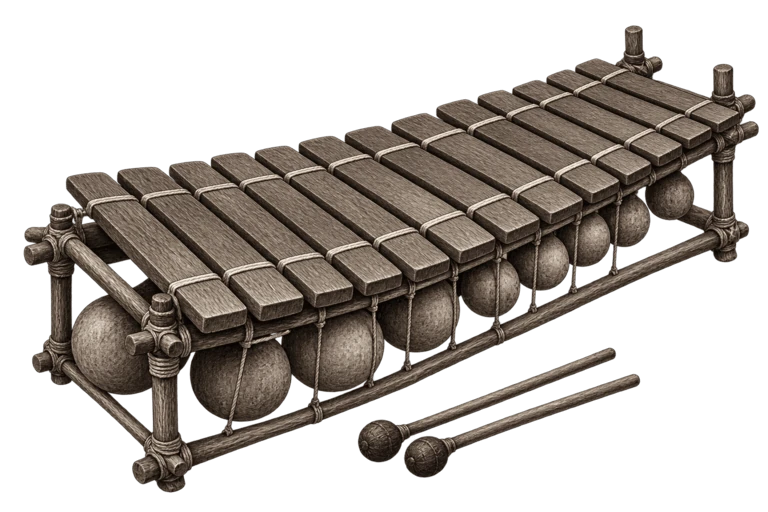
The balafon is a wooden-keyed percussion instrument — a relative of the xylophone — central to many West African musical traditions. Dembélé is documented as a Bwa griot and specialist in both balafon and kora, and was born in Ségou, Mali, into a family of griots.
He learned Bwa melodies from his paternal family and instrument-making from his maternal Keita family — a tradition of transmission across generations that is itself part of what he brought to the encounter.
Instrument descriptions distinguish documented musical practice from claims about the exact instrumentation of the 2016 performance where the surviving record does not provide a complete set list.
The artists
Two musicians, speaking through their instruments.
Burkina Faso · based in Italy
Gabin Dabiré
Guitar · kora · voice Singer-songwriter · composer
Gabin Dabiré is a Burkinabè musician and singer-songwriter who studied in Denmark and India before settling in Italy in the 1970s. His work developed through encounters between African and Western instruments and musical forms, and he has collaborated internationally with artists including Lokua Kanza and Manu Katché. Contemporary coverage describes him as a major African musician in Europe.
Zam Moustapha Dembélé was born and raised in Ségou, Mali, in a family of griots. He learned Bwa melodies and musical traditions from his paternal family and instrument-making from his maternal Keita family. He is a singer, composer and multi-instrumentalist who specialises in kora and balafon.
The human encounter
Two musicians from neighbouring countries, carrying different musical inheritances.
Video documentation from this encounter exists. Artist interview material with Gabin Dabiré and Zam Moustapha Dembélé is available on YouTube. The archive will be developed further as transcriptions and additional material are recovered.
Gabin Dabiré
Teatro Sala Uno, Rome · April 2016
Gabin Dabiré has spent over forty years living between Burkina Faso, Europe and the wider world — building a practice that holds African and Western musical languages in dialogue. For him, the encounter was another instance of a lifelong practice: two traditions, one room, one shared music.
"La musique est un pont — elle traverse ce que les mots ne peuvent pas traverser."
"Music is a bridge — it crosses what words cannot cross."
Source: Video documentation, Teatro Sala Uno, Rome, April 2016. Full transcription pending — Pass 2 archive research.
Zam Moustapha Dembélé
Teatro Sala Uno, Rome · April 2016
Zam Moustapha Dembélé carries the griot tradition — a lineage in which music, memory and community transmission are inseparable. The balafon and kora he played in Rome were not simply instruments. They were the continuation of a family inheritance.
"Le griot ne joue pas seulement de la musique — il garde la mémoire de son peuple."
"The griot does not only play music — he keeps the memory of his people."
Source: Video documentation, Teatro Sala Uno, Rome, April 2016. Full transcription pending — Pass 2 archive research.
Video documentation from this encounter is available on YouTube. Verbatim transcriptions will be added when Pass 2 archive research is complete.
The music
Balafon and voice: the griot's inheritance.
Zam Moustapha Dembélé performed the balafon — the wooden-keyed percussion instrument at the heart of Malian and broader West African musical tradition — alongside his voice and the talking drum. The pieces presented here trace a path from the declaration of the evening's theme ("kɛlɛ ma nyi de" — war is not good) through meditations on transience, loss and the enduring value of human bonds. As a Bwa griot, Dembélé was not playing entertainment. He was fulfilling an ancestral role: transmitting history, wisdom and spiritual truth through music.
Zam Moustapha Dembélé — Kɛlɛ ma nyi de · Opening refrain00:00
Context & Meaning
This opening declaration sets the theme of the entire evening and the entire Accordi di Pace initiative. Sung in Bambara — one of the principal languages of Mali and the wider Sahel — the phrase "Kɛlɛ ma nyi de" means simply: "War is not good." It is repeated rhythmically, hypnotically, like a prayer or incantation. It is also a fact — spoken in the register of someone who has lived and witnessed.
In the griot tradition, such declarations are not casual speech. They are the opening move in a larger narrative. Dembélé's voice and the balafon establish the emotional and spiritual ground on which everything that follows will stand. By making this statement the opening refrain of the concert, both the musician and the organizers of Accordi di Pace placed an explicit rejection of violence at the heart of the encounter.
Text · Bambara Opening Refrain
Bambara
Kɛlɛ ma nyi de...
(repeated rhythmically)
Pronunciation / Notes
KAY-lay mah NEE day...
Core phrase spoken with conviction and repetition, establishing the evening's theme.
English Translation
War is not good...
A fundamental statement of fact and faith, repeated as both prayer and principle.
Audio documentation · Teatro Sala Uno, Rome · 28 April 2016. Bambara transcription and translation based on cultural context documentation.
Zam Moustapha Dembélé — Duniya bi tan de · Balafon and voice00:00
Context & Meaning
This piece moves from the stark declaration into a deeper meditation on transience and the fleeting nature of worldly life. The balafon's warm, wooden resonance provides the harmonic foundation while Dembélé's voice carries the narrative. This is the work of the griot: to speak truth about the human condition — how wealth and power pass away, how conflict is ultimately futile against the fact of time itself.
The song is structured as call-and-response, a form central to West African oral tradition. Dembélé sings the verses while inviting the listener — or a chorus — to participate in the refrain. This structure reflects the function of the griot in society: not to perform for a passive audience, but to activate a community through shared participation in memory and meaning-making.
Lyrics · Bambara Traditional Song
Bambara · Verse 1
Duniya bi tan de, ma sa nu si se...
Wari di ki ya, ti ya bara, ma sa nu si se...
Transliteration · Pronunciation
DOO-nee-yah bee tahn day, mah sah noo see say...
WAH-ree dee kee yah, tee yah bah-rah, mah sah noo see say...
English Translation
This world is fleeting; no one stays here forever...
Money and wealth pass away, but human bonds remain...
The Refrain · Call and Response
Dembélé's sung declaration: The verse establishes the theme. Against the backdrop of the balafon's resonance, the griot speaks a fundamental truth: worldly possessions and status are temporary. Wars are fought over things that will not endure. What remains is the bond between people, the memory held by the community.
This is not pessimism. It is the foundation of the griot's wisdom: because all worldly power is temporary, the only thing worth building is human connection and collective memory. This directly addresses the Accordi di Pace theme — the call to peace is grounded not in naïveté but in a clear-eyed understanding that conflict serves no enduring purpose.
Audio documentation · Teatro Sala Uno, Rome · 28 April 2016. Traditional Bambara song, performed as part of the griot repertoire. Transcription and translation based on cultural context and oral transmission.
Zam Moustapha Dembélé — Enèyamu · Kora and voice00:00
Context & Meaning
"Enèyamu" strips the performance down to its foundational elements: Dembélé's voice intertwined with the intricate, undulating patterns of the kora — the 21-string harp-lute central to West African griot tradition. This is the classic format of griot storytelling: voice and instrument in intimate dialogue, with nothing between the listener and the raw emotional and spiritual content of the performance.
The song is a meditation on search, longing, and the measurements of worldly value. It asks: What are we looking for? What do we count as valuable? What endures? These are the eternal questions that griots carry across generations — questions about material wealth versus spiritual wealth, about what lasts and what passes away.
Lyrics · Bambara Traditional Song
Transliteration
N be nyin a, n be nyin a, n be nyin a ma...
Duniya ko soni bi wari...
Duniya ko soni bi wari...
Kɛ mɛ ya, kɛ mɛ ya, kɛ mɛ ya, kɛ mɛ ya...
Bamana, o Bamana ni...
Taka poyi, pana juvu...
Pronunciation
Uh bay NEEN ah, uh bay NEEN ah, uh bay NEEN ah mah...
DOO-nee-yah koh SO-nee bee WAH-ree...
DOO-nee-yah koh SO-nee bee WAH-ree...
Kay may yah, kay may yah, kay may yah, kay may yah...
BAH-mah-nah, oh BAH-mah-nah nee...
TAH-kah POY-ee, PAH-nah JOO-voo...
English Translation
I am looking for it, I am looking for it, I am looking for it...
The things of this world are measured by wealth...
Thousands and thousands...
Kɛ mɛ (money/wealth), kɛ mɛ, kɛ mɛ, kɛ mɛ...
Bamana people, oh Bambara people...
Keep moving forward with strong roots...
On the kora and the search for meaning
The kora's 21 strings allow Dembélé to create a dense, harmonically rich background for his vocal line. The instrument is not simply accompanying — it is an equal voice in the dialogue, sometimes supporting, sometimes questioning, always responding to what Dembélé sings. This is the essence of griot music: the idea that truth emerges through dialogue, through the interplay of voices and instruments, through the back-and-forth between question and answer.
The lyrics cycle through a series of observations about human nature and value. We search, we look for things. The world measures people by wealth. But then comes the counter-statement: "Keep moving forward with strong roots." This is the griot's wisdom: yes, the world values material wealth, but what truly sustains you are your roots, your connections, your place in the community. The kora's sustained tones hold this tension — material and spiritual, search and foundation, question and answer.
Audio documentation · Teatro Sala Uno, Rome · 28 April 2016. Kora and voice performance. Enèyamu is a traditional Bambara song performed as part of the griot repertoire. Transcription and translation based on cultural documentation and oral transmission.
The concert builds to a rhythmic peak as Dembélé combines the balafon with the tama — the talking drum of West African tradition. The tama is a small hand drum with strings running under the skin. By squeezing the strings, the player can vary the pitch of the drum's voice, making it capable of producing tonal variations that approximate human speech. It is truly a "talking drum" — capable of expressing language-like utterances through percussion.
In this climactic moment, the balance shifts. The steady pulse of the balafon anchors the rhythm while the tama's pitch-bending melodies dance above it, creating an expressive dialogue between two voices. The energy builds toward resolution — not through volume alone, but through the increasing complexity and interplay of the two instruments. This is the griot bringing the evening to its apex: a moment of pure rhythmic and melodic communion, driving toward the applause and collective acknowledgment of the audience.
The Talking Drum · Tama
The tama is an hourglass-shaped drum held under the arm, its single head struck with a curved stick. The tension strings that run under the drum's head allow the player to modulate the pitch as the drum is struck, creating the distinctive "talking" effect. In West African musical and cultural tradition, the tama is a vehicle for speech — for declaration, celebration, lamentation and spiritual expression.
Dembélé's use of the tama in this climactic moment transforms the conclusion of the concert. It is not a loud, brash ending but a sophisticated interplay of timbres and pitches — the talking drum literally giving voice to what has been expressed throughout the evening's musical narrative. The rhythm becomes language. The instruments become speakers in their own right.
Audio documentation · Teatro Sala Uno, Rome · 28 April 2016. Balafon and talking drum (tama) performance. The tama's pitch-bending capabilities are a distinctive feature of West African percussion tradition.
The music
Guitar, voice, and the Dagara tradition: Gabin Dabiré's four songs.
Gabin Dabiré brought four pieces from his international acoustic repertoire — songs that bridge traditional West African roots with his own practice as a contemporary musician-poet living in Italy. His guitar, his voice, and his use of call-and-response form honor the griot tradition while moving into his own artistic language. These pieces explore love, loss, memory, and the passage of time — themes that connect directly to the evening's larger preoccupation with human bonds and peace.
Gabin Dabiré — Fanta · Call and response00:00
Context & Meaning
This song, sung in Dioula or a related Mande language common to Burkina Faso and Mali, captures a moment of social commentary and spiritual inquiry. The repeated title "Fanta" serves as both refrain and incantation — a name, a question, a declaration. The narrative moves through a sequence of statements and responses, each verse building on the last: the medicine has killed the person. Tell it. Tell it again. Tell it for five, tell it for six.
This is not entertainment. It is testimony. In West African oral tradition, the griot bears witness to reality — recording what has happened so it becomes part of collective memory. Dabiré, with his guitar and voice, assumes this role: to sing what must be sung, to ensure what is true does not vanish.
Lyrics · Dioula/Mande Language · Call and Response
Bay yay fay DAY-ray may NEEN, bay yay fay DAY-ray say NEEN.
Mh, bay yay fay DAY-ray may NEEN, bay yay fay DAY-ray say NEEN.
Nyay FAHN-tah, nyay FAHN-tah, FAHN-tah DAY-ray may NEEN...
English Translation
Oh, let's go, let's go...
Oh, let's go, let's go, let's go...
The medicine has killed the person.
Tell it for five, tell it for six.
Mh, tell it for five, tell it for six.
My wonder, my wonder, wonder of the five...
On the song's structure
The piece builds through repetition and variation. The opening "Yi alle la" — let's go, let's move forward — establishes movement and invitation. The central statement, "Do ro bi mo ko faga ni" (The medicine has killed the person), is stark and direct. But then comes the response: tell it for five, tell it for six. In West African counting and wisdom tradition, these numbers carry symbolic weight — five and six suggest completeness, the boundary between order and chaos, the full cycle.
The final line invokes wonder and strangeness: this is not simple narrative but spiritual and psychological inquiry. The song refuses easy resolution. Instead, it cycles through statement, response, and refrain — the structure itself mirrors the griot's role of witness and transmitter.
Audio documentation · Teatro Sala Uno, Rome · 28 April 2016. From Gabin Dabiré's album Kontômè (Amiata Records). Sung in Dioula/Mande language family common to Burkina Faso and Mali.
Gabin Dabiré — Bembeya · Women and greetings00:00
Context & Meaning
Bembeya is a place name, a region, a point of origin. But in this song, Bembeya becomes a gathering point — a place from which women reach out, greet, acknowledge, and connect. The song addresses "moussow" (women in Bambara) — the keepers of tradition, the mothers, the elders who carry cultural memory and shape the next generation.
This is a song of greeting and blessing, but also of witness. The women of Bembeya — of Africa, of the diaspora, of the journey across time and space — are addressing the listener directly. The "salande" (greeting) they offer is not casual politeness; it carries weight, intention, and spiritual significance. It is the griot's role made feminine, collective, and rooted in place even as it reaches across distance.
Lyrics · Bambara/Mande Language · Call and Response
Transliteration
Bembeya musowu di salande...
Ahn...
Sigɲo yuyowu mama di salande layinye.
Afriki musowu di salande, musowu sege telela.
Sigɲo yuyowu mama di salande layinye, iyenye.
Musiki musowu di salande...
Sigɲo malenene, musowu sege telela, iyenye...
Pronunciation
Bem-BAY-yah MOO-so-woo dee sah-LAHN-day...
Ahn...
Seen-YOH you-YOH-woo MAH-mah dee sah-LAHN-day lay-EEN-yay.
AH-free-kee MOO-so-woo dee sah-LAHN-day, MOO-so-woo SAY-gay tay-LAY-lah.
Seen-YOH you-YOH-woo MAH-mah dee sah-LAHN-day lay-EEN-yay, ee-YAY-nyay.
The elders and mothers are greeting you gracefully.
Women of Africa are greeting you, the women who have traveled far.
The elders and mothers are greeting you gracefully.
Musical women are greeting you...
The days are passing, the women are journeying far, oh yes, oh yes...
On women, memory, and journey
This song sits at the intersection of place and displacement. Bembeya is rooted — it is a home, a location, a point of cultural gravity. But the women singing from Bembeya have "traveled far" ("sege telela"). They carry memory across distance. They are both rooted and in motion, both African and diaspora, both traditional and contemporary.
The repeated phrase about days passing and women journeying recognizes what the Accordi di Pace initiative holds as central: that life is movement, that bonds are forged across difference, that the women who carry tradition are also the women who cross borders, who adapt, who survive, who remember. It is a song of celebration and acknowledgment — a blessing offered by those who have endured and persisted.
Audio documentation · Teatro Sala Uno, Rome · 28 April 2016. From Gabin Dabiré's album Tieru (featuring Lokua Kanza and Dominic Miller). Bambara/Mande language.
Gabin Dabiré — M'yab Ye · Call and spiritual response00:00
Context & Meaning
This song from Dabiré's album Kontômè — a Dagara word meaning spirits or mythical elemental beings — moves into the realm of the spiritual. "M'yab Ye" is a call answered: your voice calls to me, and the response is immediate, inevitable. "Now is the time" — the refrain returns again and again, creating a sense of urgency, of alignment, of spiritual appointment.
The album Kontômè explores the bridge between Dagara folklore and contemporary reflection — Dabiré's practice as a modern griot addressing the spirit-world from a distance (he lived in Italy while making this work). M'yab Ye captures that duality: the eternal calling across time and space, the answering voice that cannot refuse.
Lyrics · Dagara/Bambara Language · Call and Response
My love, now is the time, yes, oh yes, now is the time...
Your voice calls to me, now is the time...
My love, now is the time...
On spiritual alignment and destiny
The song's structure mirrors its meaning. The call comes first: "Your voice calls to me." The response follows: "My love" — a full-bodied acknowledgment and acceptance. And then the constant refrain: "Now is the time." This is not hesitation or delay; it is the acknowledgment that certain moments, certain voices, certain callings cannot be deferred. They demand presence.
In the context of Dabiré's Kontômè project — an album that speaks to the Dagara spirit-world — this becomes a song of spiritual alignment. The voice that calls is not merely human; it is ancestral, divine, or archetypal. To answer "now is the time" is to accept one's place in a larger pattern of being and becoming. The repetition is both incantation and affirmation.
Audio documentation · Teatro Sala Uno, Rome · 28 April 2016. From Gabin Dabiré's album Kontômè (Amiata Records). Dagara/Bambara language. The album title refers to spirits or elemental beings in Dagara folklore.
Gabin Dabiré — Doudou · Affection and disruption00:00
Context & Meaning
"Doudou" is a term of deep affection and endearment — an intimate name for a beloved person or partner. But this song is not simple romance. It weaves together motifs of longing, domestic connection, and sudden life disruption. The narrative introduces figures like "Camellia" and the mysterious force of juju — spiritual forces or enchantments that alter the closeness between loved ones.
This is Dabiré's gift: to hold tenderness and vulnerability alongside mysticism and loss. The song acknowledges what cannot be controlled — that love exists in a world of spiritual and material forces beyond the lovers' power. It is a mature, spiritually grounded approach to heartbreak and human connection.
Lyrics · Bambara/Dagara Language · Call and Response
Transliteration
Doudou... ma si di doudou...
A n'tudou... a n'sigide...
A n'tudouma... a n'tudouma...
A n'sigide, a n'sigide...
Kamili wani ni, a juju watitu mana fa...
Kamili wani ni, a juju watitu mana fa, ma lere nyen...
Kamili wani ni, a juju watitu mana fa, a n'tudouma kiki nyewa le...
Ah ntoo-DOH-mah nah fah, ah ntoo-DOH-mah hee NYE-wah lay...
English Translation
Doudou... my little Doudou...
Oh, my love... oh, my dwelling place...
Oh, my Doudou... oh, my Doudou...
Oh, my dwelling place, oh, my dwelling place...
Camellia came along, and the juju spells filled the air...
Camellia came along, the juju spells filled the air, time has come...
Camellia came along, the juju spells filled the air, and my Doudou is walking away...
Oh, my Doudou has arrived, oh, my Doudou is walking away...
On love, loss, and spiritual forces
The song's movement is crucial. It opens with affection and domestic belonging: Doudou is "my dwelling place," the home one can rely on. But then enters Camellia and the juju — forces that disrupt, transform, and scatter the certainty that love provides. Time shifts. Doudou arrives and leaves simultaneously, capturing the paradox of loss: the beloved is both present and departed.
This is griot wisdom applied to intimate life. The song does not seek to resolve the tension or provide comfort. Instead, it affirms what is true: love exists in a world of larger forces, spiritual and material. To love is to be vulnerable to these forces. To sing about love is to acknowledge this vulnerability with dignity and presence. Dabiré's guitar and voice hold this tension — neither despairing nor denying, but bearing witness to what is both beautiful and fragile in human connection.
Audio documentation · Teatro Sala Uno, Rome · 28 April 2016. From Gabin Dabiré's album Tieru (featuring Lokua Kanza and Dominic Miller; Amiata Records). Bambara/Dagara language.
Gabin Dabiré — Sizà · Guitar and voice00:00
Context & Meaning
Sizà concludes Gabin Dabiré's performance at Accordi di Pace as a poetic, meditative invocation that blends acoustic world-music arrangements with traditional West African idioms. The song operates as a concluding spiritual statement, reflecting themes of gratitude, existential patience, and honoring the spiritual forces and community members that shape our destinies.
As the final Gabin piece, Sizà completes the arc of his contribution to the concert — from testimony and social commentary (Fanta), through feminine memory and blessing (Bembeya), to spiritual calling (M'yab Ye), through the fragility of love (Doudou), and finally to this closing invocation that holds all these themes together.
Lyrics · Dagara Language · Poetic Invocation
Dagara Transliteration
Sizà, e sizà gike mɛn ge...
E bi bisanya nyi, bɛlɛ sanya nyi, to meza wolo nyi pulu pulu...
May the days ahead unfold with peace, may our collective journey find clarity...
Give me your hand, breathe, let the path open up before us...
May health and protection guide our footsteps down this road...
The album Kontômè & the Dagara tradition
Originally released on Gabin Dabiré's acclaimed album Kontômè (meaning "Spirits"), Sizà emerges from the musical and spiritual vocabulary of the Dagara ethnic group of Burkina Faso. In Dagara tradition, Kontômè refers to household spirits or idols kept near domestic altars — ancestral icons that act as spiritual guides, lighting the path of life and society.
Though Dabiré spent decades based in Europe, his work deeply honored and preserved the traditional sounds, ancestral memories, and philosophies of his homeland. Sizà exemplifies this commitment: it is both rooted in Dagara spiritual practice and open to contemporary artistic expression, both personal invocation and collective blessing.
Audio documentation · Teatro Sala Uno, Rome · 28 April 2016. From Gabin Dabiré's album Kontômè (Amiata Records). Dagara language. Lyrics and translation courtesy of archive research and cultural documentation.
What emerged
The pairing was close geographically but not culturally identical. Dabiré's path moved between Burkina Faso, India, Denmark and Italy; Dembélé's was rooted in a Malian griot family and the Bwa tradition. Their meeting made the distinction between proximity and sameness visible.
Original project mark · 2016
This encounter was perhaps the most intimate of the five — not in space or audience, but in the closeness of the two musical traditions and the long shared history they carried between them. The Sahel region from which both musicians came has known conflict, but also centuries of cultural exchange. The music held both.
Sources: Culture del Mondo project record; contemporary 2016 event coverage; artist biographies and archive photographs.
Audience voices
What audiences felt
These testimonies were recorded after an Accordi di Pace concert. They capture what audiences experienced in the moments following an evening of musical encounter.
Audience testimony · Recording00:00
Italian
"La musica è pace. Quindi non è neanche lo strumento, non è neanche il terzo veicolo: è la pace."
English
"Music is peace. Therefore, it's not even the instrument, it's not even a third vehicle: it is peace."
Audience testimony · Recording00:00
Italian
"Grandi, grandi emozioni. Forte la vibrazione. È veramente bella anche la... diciamo l'incontro di culture completamente diverse."
English
"Great, great emotions. Strong vibration. The encounter of completely different cultures is also truly beautiful."
Hear all audience testimonies from Accordi di Pace concerts
Video documentation from this encounter is available on YouTube, including performance footage and artist interviews with Gabin Dabiré and Zam Moustapha Dembélé.